Frequently Asked Question
What is thermal transfer ribbon and how does it work?
A thermal transfer ribbon is a coated film (usually polyester/PET base) with a layer of wax, resin, or wax-resin ink that transfers onto a label or substrate when heated by a printhead, creating a durable printed image.
What’s the difference between wax, wax-resin, and resin thermal transfer ribbons?
Wax ribbons are cheapest and suit paper labels with basic durability needs
Wax-resin balances cost and resistance to smudging/scratching
Full resin ribbons offer the highest durability for chemicals, heat, and abrasion, typically used on synthetic labels.
Which thermal transfer ribbon type should I choose and use for?
- Wax Ribbons – Ideal for art paper labels and general-purpose barcode printing
- Wax Resin Ribbons – Offers better scratch and smudge resistance for coated paper and synthetic labels.
- Resin Ribbons – Provides the highest durability for synthetic labels exposed to chemicals, heat, moisture and abrasion.
How do I choose the right ribbon width and length for my printer?
We need your printer brand and model, label width to recommend the correct ribbon size:
- Ribbon width
- Ribbon length
- Ribbon core size – 1″ or 0.5″
- Ink orientation – Face In (CSI) or Face Out (CSO)
Are your thermal transfer ribbons compatible with Zebra, Sato, TSC, Honeywell printers?
Yes. Our thermal transfer ribbons are compatible with most major barcode printer brands, including:
- Zebra, SATO, TSC, Honeywell, Datamax, Toshiba TEC, Citizen, Godex, Argox, Postek, CAB, Intermec, Avery Dennison, Ring, Novexx, Brady, Diagraph, Fargo, Printonix and many others
What is the shelf life and storage condition for thermal transfer ribbons?
Thermal transfer ribbons typically have a shelf life of 2–3 years (unopened) from the date of manufacture when stored under the proper conditions.
For the best print quality and ribbon performance, follow these storage recommendations:
- Temperature: Store between 15°C and 30°C.
- Humidity: Maintain 20%–80% relative humidity (non-condensing).
- Keep away from direct sunlight: UV exposure and heat can damage the ribbon coating.
- Store in the original packaging: This protects the ribbon from dust, moisture, and contamination.
- Avoid extreme temperatures and humidity: Excessive heat, cold, or moisture may affect print quality and ribbon performance.
- Allow the ribbon to acclimatise: If moved from a cold environment, let it reach room temperature before use to prevent condensation.
With proper storage, thermal transfer ribbons will deliver consistent print quality and maximise printer performance.
Do you offer OEM/private label thermal transfer ribbons and what are your MOQs?
Yes, Sinazza Imaging Products Sdn. Bhd. offers OEM and private label thermal transfer ribbons for distributors, resellers, wholesalers, and brand owners.
Our OEM services include:
- Custom brand name and logo printing
- Custom packaging and labels
- Barcode and product label design
- Ribbon specifications tailored to your requirements
- Bulk manufacturing for local and export markets
Minimum Order Quantity (MOQ):
- The MOQ depends on the ribbon type, size, packaging requirements, and level of customisation.
- Standard ribbon sizes and packaging generally require a lower MOQ than fully customised products.
What certifications does your thermal transfer ribbon comply with (RoHS, REACH, ISO)?
Our thermal transfer ribbons are manufactured to meet internationally recognised quality and environmental standards.
Depending on the ribbon grade and manufacturer, our products comply with:
- RoHS Compliant
- REACH Compliant
- ISO 9001 Certified Manufacturing
- ISO 14001 Certified Manufacturing
How does thermal transfer printing differ from direct thermal printing?
Thermal transfer uses a ribbon and works on non-heat-sensitive materials for longer-lasting prints, while direct thermal needs heat-sensitive paper and fades faster, especially with heat/sunlight exposure.
Where can I buy thermal transfer ribbons in bulk from Malaysia/Southeast Asia?
Sinazza Sdn. Bhd. is a leading thermal transfer ribbon (TTR) manufacturer and authorized slitting specialist based in Kulim, Kedah, Malaysia. We supply high-quality thermal transfer ribbons in bulk to businesses across Malaysia, Singapore, Thailand, Indonesia, Vietnam, the Philippines, and other Southeast Asian markets.
We serve a wide range of industries, including logistics, manufacturing, food & beverage, pharmaceuticals, retail, automotive, and electronics. Whether you require standard ribbon sizes or custom OEM/ODM solutions, we can provide products tailored to your application and printer requirements.
Our B2B ordering process is simple:
- Send us your inquiry – Share your ribbon specifications, printer model, ribbon size, ink type (Wax, Wax/Resin, or Resin), quantity, and application.
- Receive a quotation – Our sales team will recommend the most suitable product and provide a competitive quotation.
- Sample evaluation (optional) – We can arrange samples for testing before mass production.
- Order confirmation – Once approved, we confirm your order, production schedule, and delivery timeline.
- Production & shipping – Orders are manufactured, quality-checked, and shipped from our facility in Malaysia to your destination.
With years of experience in the thermal transfer ribbon industry, Sinazza is committed to delivering consistent quality, reliable lead times, and responsive technical support to customers throughout Southeast Asia.
Differences between Wax, Wax Resin and Resin
| Feature | Wax | Wax-Resin | Resin |
|---|---|---|---|
| Composition | Mainly wax | Wax + resin | Mainly resin |
| Print quality | Good | Very good | Excellent |
| Durability | Low–medium | Medium–high | Very high |
| Scratch resistance | Low | Good | Excellent |
| Heat resistance | Low | Medium–high | High |
| Chemical resistance | Low | Good | Excellent |
| Moisture resistance | Low | Good | Excellent |
| Print speed | High | High | Medium–high |
| Print temperature | Low | Medium | Higher |
| Cost | $ Lowest | $$ Medium | $$$ Highest |
| Recommended materials | Paper labels | Paper, coated & synthetic labels | Synthetic labels, PET, PP, PE |
| Typical applications | Shipping labels, cartons, general labels | Product labels, retail, logistics, manufacturing | Industrial, chemical, automotive, outdoor labels |
| Best for | General-purpose printing | Balance of quality & durability | Maximum durability |
- Wax – Economy
Best for paper labels and general-purpose applications where high durability is not required.
- Wax-Resin – Versatile
A good balance between print quality, durability and cost. Suitable for applications requiring better scratch and environmental resistance.
- Resin – Premium
Best for synthetic labels and demanding applications requiring excellent resistance to scratching, chemicals, heat and moisture.
Easy selection guide
Paper + low durability requirement → WAX
Synthetic + medium durability → WAX-RESIN
Polyester + high durability requirement → RESIN
How to identify your printer is using Flat Head or Near Edge ribbons?
| Feature | Flat Head | Near-Edge |
| Printhead position | Flat | Angled |
| Contact area | Larger/flat | Small contact point |
| Printing speed | Normal–high | Very high |
| Ribbon type | Flat Head TTR | Near-Edge TTR |
| Common application | Labels, tags, packaging | High-speed packaging/films |
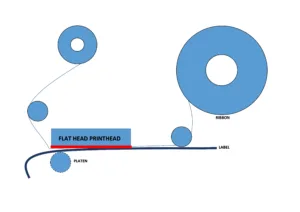
Flat Head is the most common type.
- Printhead is positioned relatively flat/horizontal against the label.
- Ribbon and label travel in the same direction under the printhead.
- Printing usually occurs at a 90° contact angle.
- Common in Zebra, TSC, Honeywell, SATO desktop and industrial printers.
- Usually uses standard Flat Head Thermal Transfer Ribbons.
Simple way to remember:
➡️ Ribbon → Label → Printhead pressing down
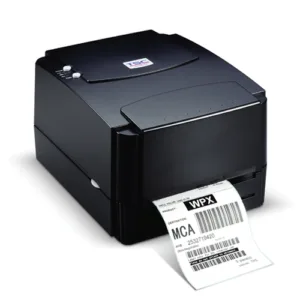
Example for Flat Head printer – TSC TTP-244 PRO
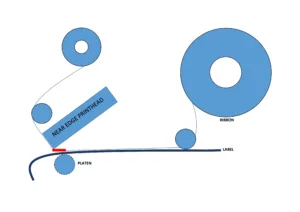
Near-Edge (also called Corner-Edge) has a different printhead design.
- Printhead is positioned at an angle, rather than flat against the label.
- The ribbon and label pass the printhead at a high-speed, angled contact point.
- Printing occurs very close to the edge/corner of the printhead.
- Designed for high-speed printing.
- Common in applications such as packaging, flexible film and high-speed labeling.
- Requires Near-Edge/CORNER-EDGE compatible ribbon.
Simple way to remember:
➡️ Ribbon → Label → Printhead touches at an angle/edge
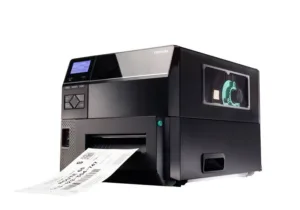
Example for Near Edge printer – Toshiba B-EX6T
How do I know whether my printer uses an Inking Face Inside (CSI) or Inking Face Outside (CSO) ink-coated ribbon?
Thermal transfer ribbons are made from a base film coated with ink and then wound onto a core. The ribbon can be wound in two ways: Coated Side In (CSI), where the ink coating is on the inside, or Coated Side Out (CSO), where the ink coating is on the outside.
Think of a roll of tape as an example. The adhesive side is wound toward the inside of the roll, similar to how the coated side is positioned on a CSI ribbon.
Most thermal transfer printers are designed to use either CSI or CSO ribbons, although some printer models are compatible with both types. The position of the ink coating determines how the ribbon should be installed in the printer.
During printing, the ink-coated side must face the substrate so that the ink can be transferred onto the material when heated by the printhead. Therefore, a CSI ribbon typically unwinds from the top, while a CSO ribbon typically unwinds from the bottom.
It is important to know whether your printer requires a CSI or CSO ribbon before purchasing, as using the correct ribbon type ensures proper installation, printing performance, and compatibility with your printer.
Check your printer manual or the direction in which the ribbon is installed. If you’re unsure, simply provide your printer model and we can recommend the correct ribbon.
Example Printer brand
Printer for using Inking Outside Ribbons (CSO) – TSC TTP-244 Pro
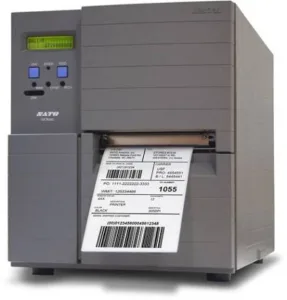
Printer for using Inking Inside Ribbons (CSI) – Sato LM408